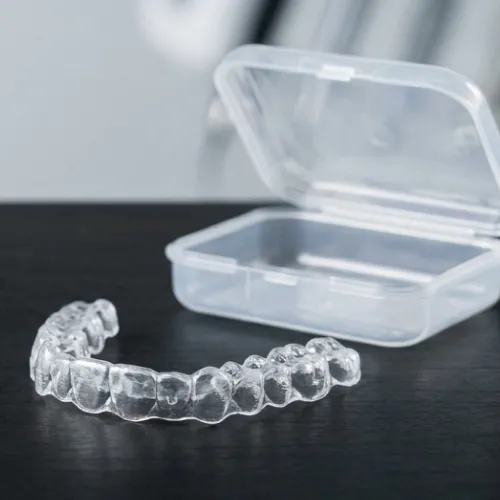
Spark vs. Invisalign: Which Clear Aligner Is Actually Better?
Spark vs. Invisalign: Which clear aligner is actually better for you? Compare costs, comfort, and results. Book your smile consultation in Richmond today!
Read More

Cosmetic Dentistry
Medically Reviewed by Dr. Ali Tameemi
Dental bonding and teeth whitening solve different problems — and choosing the wrong sequence can force you to redo expensive work. Before scheduling either treatment, understanding how insurance coding works and why the order of procedures matters will save you significant time and frustration.
Most patients ask which treatment is better. The smarter question is which comes first. For Richmond-area patients, understanding the chemistry of these materials is the first step.
Composite resin — the material used in dental bonding — does not respond to peroxide-based whitening agents. According to WebMD, bleaching products will not whiten tooth-colored composite bondings, only your natural enamel. This creates a serious sequencing problem that most patients discover too late.
Here's what happens: if you bond first, then decide to whiten six months later, your natural teeth will brighten while your bonded teeth stay the original shade. The result is a mismatched smile that requires fully replacing the bonding work to correct it — at full cost, all over again.
The correct sequence is always whiten first, then bond. Research published on PMC (NIH) suggests waiting at least 14 days after whitening before placing composite resin, because residual peroxide in enamel inhibits proper bonding adhesion. Rush the timeline and the bond itself may fail prematurely.
The practical takeaway for Richmond patients: arrive at your target tooth shade before your bonding appointment. That's the shade your composite will be matched to — permanently. Trying to adjust afterward means starting over. If you're considering pro teeth whitening as part of your smile plan, establishing that baseline shade first is essential.
Dental insurance coverage for bonding isn't simply "cosmetic versus restorative." It comes down to how the procedure is clinically coded — and that distinction is worth understanding before your appointment.
When bonding closes a gap purely for appearance, it's typically coded as a cosmetic procedure and receives no coverage. However, the same bonding material applied to repair a chipped edge caused by wear, protect an exposed root after gum recession, or restore a tooth affected by decay can be coded under restorative categories — shifting coverage from zero to a meaningful percentage of the procedure.
As Healthline explains, dental bonding can repair decayed, cracked, or fractured teeth and protect exposed roots — all clinically justified uses. Before your appointment, ask your dentist to document findings like incisal wear, enamel fractures, or decay adjacent to the area being bonded. Those clinical notes are what support a restorative code during insurance review.
Questions worth raising with your dentist before treatment:
If the answer to any of these is yes, there may be grounds for coverage. If the answer is no, plan accordingly — cosmetic bonding is an out-of-pocket decision. It's also worth reviewing your dental insurance plan details ahead of time so you understand exactly what restorative and cosmetic codes your policy recognizes.
These two treatments are not interchangeable. They address fundamentally different issues.
Teeth whitening targets staining and discoloration within the natural enamel. It works well for extrinsic stains from coffee, tea, or tobacco, and for the general yellowing that comes with age. WebMD notes that whitening is a chemical process that lightens natural tooth structure — it has no effect on chips, cracks, gaps, or shape irregularities.
Dental bonding, by contrast, physically adds material to a tooth. A Healthline overview of dental bonding outlines its uses: repairing chips and cracks, closing spaces between teeth, reshaping teeth, and covering discoloration that whitening cannot reach — such as intrinsic staining from medications or developmental conditions. For patients whose concerns go beyond surface staining, aesthetic dentistry options like bonding, porcelain veneers, or alignment treatments may be worth exploring as part of a broader smile plan.
The material grade used in bonding also matters more than patients expect. Standard hybrid composites are designed for strength and work well on back teeth. High-polish nanofill or microfill composites are used on visible front teeth specifically because they can be layered in multiple shades and translucencies to mimic how natural enamel transmits light. A single-shade, opaque composite may look noticeably artificial and stain faster. When front teeth are involved, the composite type and the skill of application determine the long-term result — not just whether bonding was chosen over whitening.
For patients with both concerns — staining and structural issues — the answer is usually both treatments, in the right order: whiten first, wait two weeks, then bond to the new shade. Patients dealing with alignment issues alongside cosmetic concerns may also want to consider Invisalign before finalizing any bonding work, since tooth position affects how bonding is shaped and placed.
Choosing between whitening, bonding, or both is easier with a dentist who can examine your teeth and explain exactly what each treatment will and won't accomplish for your specific situation.
Nu Dentistry Richmond serves patients throughout Richmond, Texas and the greater Houston area. Schedule a consultation — or check out our current dental offer — to get a clear picture of your options before the sequencing trap costs you extra work.
Medical disclaimer: This article is for informational purposes only and does not constitute professional dental or medical advice. Always consult a licensed dental professional for diagnosis and treatment recommendations specific to your oral health.




Tuesday 9-6pm
Thursday 9-6pm
Saturday 9-2pm
11115 W Grand Parkway S, Suite 140, Richmond, TX 77407
5706 San Felipe St Ste B-300, Houston, TX 77057
23227 Gosling Rd., Suite B, Spring, TX 77389
8940 Barker Cypress Rd., Cypress, TX 77433
3201 N. Shepherd Dr. Suite 113, Houston, TX 77018
8145 Highway 6, Building B #200, Missouri City, TX 77459
PATIENT TESTIMONIALS Richmond, TX
What People Are Saying After Visiting Us




CARING DENTISTS Richmond, TX
OUR SOCIALS
Check Us Out and Follow Our Social Media Accounts